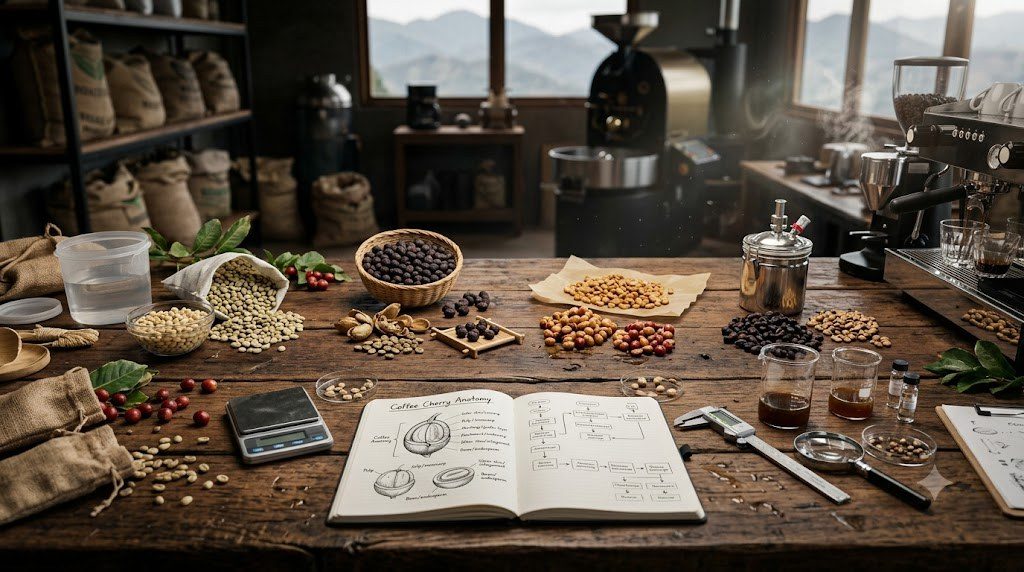
Carpology, Microbial Ecology & Fermentation Kinetics
A rigorous biochemical and anatomical treatise on post-harvest coffee processing. We break down the concentric cellular layers of the coffee cherry—exocarp, mesocarp mucilage, endocarp parchment, and perisperm silverskin—and evaluate the biochemical pathways of wet washing, natural drying, honey modulation, and carbon dioxide anaerobic maceration.
The journey from a ripe crimson fruit hanging on a tree branch to a stable, exportable green coffee bean is governed by post-harvest processing. While varietal genetics establish the biological ceiling of potential, post-harvest processing dictates whether that potential is realized, altered, or destroyed. A single lot of cherries harvested from the same hillside can taste vibrant, citrusy, and tea-like if processed via wet washing, or boozy, heavy-bodied, and jammy if processed via extended natural fermentation.
Far from being a passive drying exercise, modern coffee processing is an intricate application of agricultural biotechnology, microbiology, and heat and mass transfer. To understand how processing sculpts sensory profiles, one must first master the physical carpology of the coffee cherry.
1. Carpology and Anatomical Morphology of the Coffee Fruit
The coffee cherry (botanically a drupe or pseudoberry) is organized into five distinct concentric morphological layers protecting the two opposing seeds (the endosperm):
- Exocarp (Skin / Epicarp): The tough outermost layer consisting of a single layer of parenchymatous cells covered by a waxy, water-repellent cuticle. During ripening, chloroplasts degrade and anthocyanins and carotenoids synthesize, shifting the skin color from deep green to bright red, orange, or yellow depending on cultivar genetics.
- Mesocarp (Flesh & Mucilage): Located directly beneath the skin. In unripe cherries, this layer is hard and rigid. As ripening progresses, pectolytic enzymes break down insoluble pectins into soluble, hydrophilic pectins, creating a sticky, viscous, sugar-rich hydrogel known as Mucilage. The mucilage contains roughly 80% water, 14% simple sugars (glucose, fructose, sucrose), 2% pectin, and 1% organic acids.
- Endocarp (Parchment / Pergamino): A rigid, fibrous, cellulosic shell that encloses each bean. Composed of lignified sclerenchyma cells, the parchment acts as a protective barrier against fungal infection and insect penetration during the post-harvest drying phase.
- Perisperm (Silverskin / Testa): A paper-thin, silvery tegument directly adhering to the seed endosperm. Remnants of the silverskin persist even through drying and are shed as ‘chaff’ during thermal roasting.
- Endosperm (The Green Seed): The commercial core of the coffee cherry. The endosperm cells contain the mineral salts, sucrose, caffeine, chlorogenic acids, and lipid reserves intended to nourish the developing plant embryo upon germination.
2. The Washed (Wet) Process: Cleanliness, Enzymatic Clarity, and Demucilation
In the Washed (Wet) process, the objective is to mechanically strip away the skin and pulp and remove the mucilage layer before the parchment coffee is laid out to dry. Washed processing delivers supreme terroir clarity, highlighting the pure varietal characteristics and high-altitude malic and phosphoric acidity of the lot.
The standard steps of modern wet processing follow an exacting protocol:
- Hydro-Sorting and Density Flotation: Freshly picked cherries are unloaded into water tanks (sifones). Under-ripe, defective, or insect-damaged cherries float to the surface (known as ‘floaters’ or boyas) and are skimmed away, while dense, fully ripe cherries sink to the bottom.
- Mechanical Depulping: Dense cherries pass through calibrated pulping machines (disc or drum pulpers) that peel off the outer skin (exocarp) while leaving the parchment-covered seeds coated in sticky mucilage.
- Underwater Fermentation Tanks: The mucilage-coated seeds are submerged in tiled concrete fermentation tanks for
12 to 36 hours. During this stage, native microflora—primarily lactic acid bacteria, yeasts (Saccharomyces cerevisiae, Pichia kluyveri), and endogenous plant enzymes (pectin lyase, polygalacturonase)—hydrolyze the insoluble pectin matrix into water-soluble galacturonic acid. - Canal Washing and Grading: Once the mucilage has completely liquefied (traditionally verified when a wooden pole placed in the tank produces a squeaking friction sound against clean parchment), the coffee is flushed through serpentine concrete channels. Vigorous agitation removes remaining mucilage residues and sorts beans by weight.
3. The Natural (Dry) Process: Osmotic Sugar Ingress and Sun Drying
The Natural (Dry) process is the oldest and most traditional method of coffee processing, originating in the arid highlands of Ethiopia and Yemen where access to clean flowing water was historically limited. In this method, the freshly picked cherries are laid directly out into thin layers on raised African drying beds or brick patios with all fruit layers (skin, pulp, and mucilage) intact.
As the cherries dry under the sun over a period of 15 to 30 days, complex biochemical interactions occur:
- Osmotic Migration of Solubles: As moisture evaporates through the exocarp, sugars, fruit acids, and soluble phenolics within the drying mesocarp migrate through the semi-permeable parchment into the seed endosperm via capillary pressure and osmotic gradients.
- Aerobic Microbial Succession: Epiphytic wild yeasts and molds colonize the cherry skin, metabolizing sugars into fruity esters (ethyl acetate, ethyl butyrate, isoamyl acetate), yielding unmistakable tasting notes of ripe strawberry, blueberry, passionfruit, and dark chocolate.
- Moisture Monitoring and Rot Prevention: Cherries must be systematically raked and turned every 30 to 60 minutes during peak sunlight to prevent localized moisture traps, which trigger mold growth, ochratoxin-A contamination, and uncontrolled phenolic rot. Drying is complete when internal bean moisture drops to
10.5%–11.5%.
| Processing Method | Fruit Layers Retained During Drying | Water Usage | Fermentation Mechanism | Typical Sensory Cup Profile |
|---|---|---|---|---|
| Fully Washed | Parchment only (mucilage completely removed) | High (2–5 L/kg) | Submerged microbial pectin hydrolysis | High clarity, crisp citric/malic acidity, floral, tea-like body |
| Natural (Dry) | 100% of fruit (Skin, pulp, and mucilage) | Zero (dry process) | Aerobic surface fermentation on drying beds | Heavy body, jammy fruit, blueberry, boozy sweetness, low acidity |
| Yellow / White Honey | 10% – 50% mucilage retained | Low | Rapid patio drying with minimal fermentation | Balanced, clean stone fruit, apricot, crisp honey sweetness |
| Red / Black Honey | 80% – 100% mucilage retained (skin removed) | Low | Thick layer slow drying on raised beds | Syrupy mouthfeel, dark plum, brown sugar, red apple acidity |
| Anaerobic Fermentation | Sealed tanks (whole cherry or pulped) | Low-Moderate | Oxygen-depleted pressurized carbon dioxide | Intense cinnamon, bubblegum, tropical punch, lactic yogurt acidity |
4. The Honey (Pulped Natural) Spectrum
Pioneered in Costa Rica and Brazil, the Honey process (also termed Pulped Natural) bridges the gap between washed and natural methods. The outer cherry skin is mechanically removed, but some or all of the sticky mucilage layer is retained on the parchment during drying.
Producers categorize honey coffees based on the percentage of mucilage retained and the drying regime deployed:
- White & Yellow Honey: Between 10% and 50% of the mucilage is retained. The coffee is dried quickly under direct, intense sunlight for 7 to 10 days, resulting in a cup with clean citric acidity, mild floral notes, and delicate sweetness.
- Red Honey: Roughly 50% to 75% of mucilage is preserved. The drying process is slower, often shaded during peak midday heat, taking 12 to 16 days. The coffee develops notes of cherry, melon, and caramel.
- Black Honey: 100% of the mucilage is retained. The parchment is dried in thick beds under shade cloth, taking upwards of 20 to 25 days. The coffee develops profound body, raisin-like sweetness, and dark molasses complexity reminiscent of a high-grade natural.
5. Controlled Anaerobic and Carbonic Maceration Innovations
Over the past decade, specialty coffee producers have adopted advanced techniques adapted from the wine industry: Anaerobic Fermentation and Carbonic Maceration.
In these modern protocols, freshly picked whole cherries or pulped parchment are sealed into airtight stainless steel bioreactors or high-density polyethylene barrels equipped with one-way gas release valves. The key principles include:
- Oxygen Depletion: The vessels are flushed with food-grade carbon dioxide (CO2) gas, creating an oxygen-free environment that suppresses obligate aerobic spoilage organisms (such as Acetobacter and wild filamentous molds).
- Lactic and Malic Dominance: Under anaerobic conditions, facultative anaerobes—primarily lactic acid bacteria (Lactobacillus and Leuconostoc species)—thrive, converting sugars into lactic acid rather than harsh acetic acid (vinegar). This imparts a silky, creamy mouthfeel reminiscent of Greek yogurt, accompanied by complex spiced notes (cinnamon, clove, cardamom).
- Temperature and pH Control: Leading producers monitor internal vat temperatures with thermal probes (keeping temperatures cold, around 12°C–15°C, for slow extended fermentation) and continuously track pH, halting fermentation when pH drops from an initial 5.8 down to a precise target between 4.0 and 3.8 to avoid over-fermentation.
6. Microbiology of Wet Fermentation: Yeasts, Lactic Bacteria, and Organic Acids
While coffee fermentation was historically viewed merely as a mechanical necessity to detach sticky mucilage from parchment, contemporary food science recognizes fermentation as a powerful enzymatic engine that synthesizes volatile flavor precursors. When coffee cherries are pulped and resting in fermentation tanks, an ecological succession of microorganisms transforms the chemical environment.
The microbial dynamics within the fermentation ecosystem follow a well-documented trajectory:
- The Pioneer Phase (Enterobacteria and Wild Yeasts): In the initial hours after depulping, ambient species such as Enterobacter and epiphytic wild yeasts (Saccharomyces cerevisiae, Hanseniaspora uvarum) dominate. They metabolize free glucose and fructose within the mucilage hydrogel, producing ethanol, carbon dioxide, and early aromatic esters.
- The Lactic Acid Phase: As oxygen within the tank is depleted by aerobic respiration, facultative anaerobic Lactic Acid Bacteria (LAB)—primarily Leuconostoc mesenteroides, Lactobacillus plantarum, and Weissella confusa—proliferate rapidly. LAB metabolize sugars via heterofermentative or homofermentative pathways, producing lactic acid. This shifts the tank pH from an initial
5.5–6.0 down to 3.8–4.2, creating a bactericidal environment that suppresses putrefactive and pectin-destroying spoilage bacteria. - Inoculated Fermentations with Selected Yeasts: Progressive coffee estates now utilize commercial wine and beer yeasts (such as freeze-dried Saccharomyces cerevisiae strains Lalcafe Oro and Intenso). Inoculating the tank with high concentrations of verified yeast strains suppresses unpredictable wild microbes and maximizes the enzymatic synthesis of higher alcohols (isoamyl alcohol, phenethyl alcohol) that diffuse through the porous endocarp parchment, infusing the green bean with stable floral, stone fruit, and tropical notes.
7. Drying Thermodynamics: Moisture Evaporation Kinetics and Glass Transition Physics
Following fermentation and washing, the parchment coffee contains approximately 50% to 55% moisture by weight. Bringing this water content down to the safe commercial equilibrium of 10.5% to 11.5% is the most delicate phase of post-harvest processing. Drying is not simply water removal; it is an active physical and biological stabilization process governed by glass transition physics.
The drying process proceeds through three distinct thermodynamic stages:
- Phase 1: Rapid Surface Evaporation (55% down to 35% moisture): Free, unbound water on the parchment surface and within outer cell layers evaporates rapidly. Temperatures must be carefully regulated below
40°Cto prevent thermal shock, parchment cracking, and enzyme denaturing. - Phase 2: Internal Capillary Moisture Diffusion (35% down to 20% moisture): Water molecules must now diffuse from deep within the core endosperm cells through micro-capillaries to the bean surface. If drying is forced too quickly (e.g., in aggressive mechanical silo dryers), the outer layers dry while the inner core remains wet—a condition called ‘case hardening’. When stored, this moisture redistributes, creating mold pockets.
- Phase 3: Equilibrium Desorption and Glass Transition (20% down to 10.5% moisture): At this critical stage, the cytoplasm of the coffee seed’s living cells transitions from an active, rubbery state into an amorphous, vitrified solid glassy state. In this glassy state, cellular metabolic activity virtually ceases, enzymatic degradation halts, and the seed embryo enters stable dormancy, allowing green coffee to be preserved for months without sensory fading.
8. Thermal and Microbial Cascades in Natural Patio Management
In traditional natural processing on open patios or raised African beds, temperature control represents the ultimate barrier between pristine fruit sweetness and uncontrolled fungal spoiling. When cherries are spread out under intense equatorial sunlight, internal cherry temperatures can spike above 45°C (113°F) during midday hours if cherries are piled too deep.
Such extreme thermal stress kills beneficial yeasts and denatures endogenous plant enzymes before fruit sugars can be fully metabolized into pleasant aromatic esters. Conversely, if cherries are piled too high during cool night hours, condensation forms within the cherry mass, creating hyper-humid microclimates that encourage the proliferation of xerophilic molds such as Penicillium and Aspergillus ochraceus, which produce ochratoxin-A (OTA)—a regulated nephrotoxic mycotoxin.
Specialty producers implement parabolic solar dryers and shade netting, carefully adjusting bed thickness from an initial 2 to 3 centimeters during the first 5 days of high-moisture evaporation up to 5 to 7 centimeters as moisture drops below 20%. Cherries are systematically turned every 45 minutes from sunrise to sunset and covered with breathable tarpaulins each evening to prevent condensation and dew rehydration.
In addition to bed thickness adjustments, ambient relative humidity and airflow through raised mesh beds play a pivotal role in moisture desorption rates. When ambient humidity exceeds 70% during tropical rains, raised African beds allow air to circulate beneath the fruit mass, preventing stagnant moisture pooling that frequently causes black mold in concrete patio systems. Leading producers also employ solar-powered exhaust fans in parabolic greenhouse tunnels to maintain continuous laminar airflow over drying cherries, stabilizing drying kinetics even during cloudy weather.
Processing Quality Control: Critical Measurement Thresholds
1. Brix Refractometer Monitoring: Measure cherry sugar content in the field before harvest; optimal harvesting for specialty fermentation requires readings between 20° and 24° Brix.
2. Continuous pH Tracking: During submerged washing or anaerobic tanks, record pH every 2 hours; stop fermentation precisely when pH reaches 4.0 to 3.9 to avoid over-fermented onion/acetic defects.
3. Water Activity Verification: Green coffee must never be packed for export until moisture measures 10.5%–11.5% and water activity sits strictly between 0.56 and 0.62 aw.