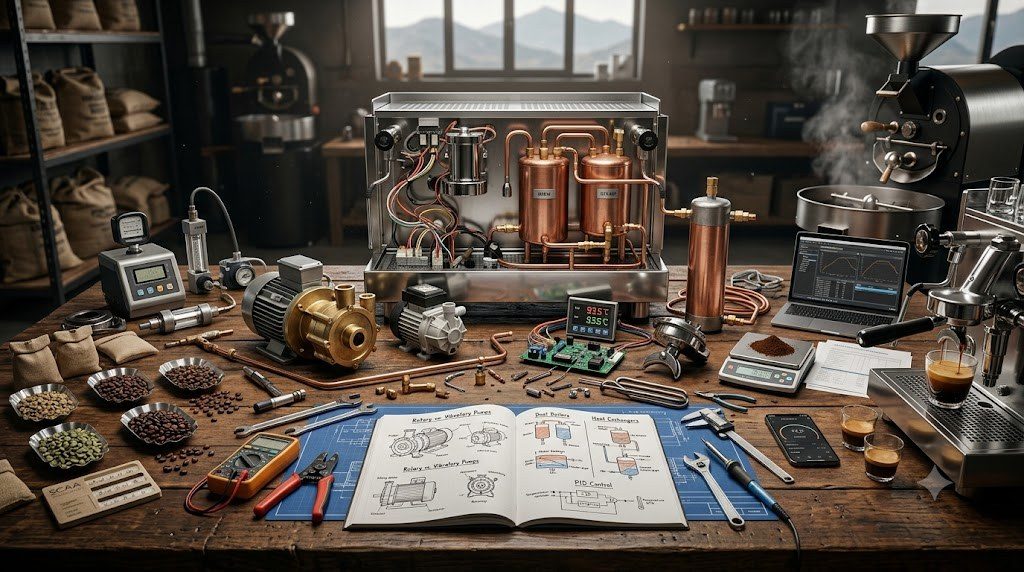
Thermodynamics & Hydraulic Mechanical Engineering
A comprehensive deep dive into the engineering principles governing modern espresso machine architecture. We investigate the physics of vibratory vs. rotary pump fluidics, model the thermodynamics of single boilers, heat exchangers, and saturated dual boilers, and analyze micro-processor PID temperature feedback loops.
An espresso machine is fundamentally an industrial precision thermodynamic reactor designed to deliver hot water at an exact temperature (typically 90°C to 96°C) under steady hydraulic pressure (6 to 9 bar) across an unsteady porous coffee bed. While consumer marketing frequently focuses on exterior aesthetics and touchscreen interfaces, the true mechanical integrity of an espresso machine rests upon its hydraulic pump engineering, thermodynamic boiler topology, and micro-controller closed-loop temperature regulation.
Thermodynamic Balance in Espresso Brewing
Espresso extraction operates in an inherently demanding thermodynamic regime. Brewing requires liquid water at precisely controlled sub-boiling temperatures (typically 92.5°C to 93.5°C for medium-density specialty beans). Simultaneously, texturing milk requires dry, saturated steam at temperatures between 125°C and 135°C, generating pressures between 1.2 and 2.0 bar. Achieving both states from a common fluid source while maintaining thermal stability during consecutive brew cycles requires sophisticated thermodynamic engineering.
Hydraulic Pump Mechanics: Vibratory Solenoids vs. Positive Displacement Rotary Pumps
The generation of hydraulic pressure within espresso machinery relies on two fundamentally different pump architectures: electromagnetic vibratory solenoid pumps and mechanical positive displacement rotary vane pumps. Vibratory pumps, ubiquitous in domestic and prosumer equipment (such as Ulka EP5 / EX5 units), operate via an alternating electromagnetic coil energized at AC line frequency (50 Hz or 60 Hz). An internal diode half-wave rectifies the electrical signal, driving a magnetized stainless steel piston against a calibrated spring 50 or 60 times per second. This reciprocating motion generates pulsating fluid compression with nominal peak pressures exceeding 15 bar, which must be attenuated via an Over-Pressure Valve (OPV) to a standard 9-bar operating baseline.
In contrast, commercial and high-end prosumer espresso architectures utilize positive displacement rotary vane pumps driven by high-torque electric motors (typically induction or brushless DC). Within a precision-machined brass or stainless steel casing, an eccentric rotor fitted with spring-loaded carbon or polymer vanes rotates smoothly. As the rotor turns, variable-volume chambers between vanes continuously draw in water from the municipal supply line and compress it in an uninterrupted, laminar stream. Rotary pumps provide immediate hydraulic pressure buildup with zero harmonic pulsation, whisper-quiet decibel levels, and the volumetric throughput capacity necessary to feed multiple group heads simultaneously without flow starvation.
Hydraulic Ramp-Up Curves: Vibe vs. Rotary
Vibratory pumps inherently exhibit a slower, progressive pressure rise (taking 4 to 7 seconds to reach 9 bar) due to internal mechanical compliance and spring oscillation. Paradoxically, this gentle ramp-up acts as a natural pseudo-pre-infusion, often forgiving minor puck channeling in domestic setups. Rotary pumps deliver instantaneous 9-bar line pressure within 0.5 seconds, demanding precise puck preparation or engineered pre-infusion chambers to prevent surface scouring.
Thermodynamic Architecture: Single Boiler Dual Use vs. Heat Exchanger (HX) vs. Saturated Dual Boiler
The thermodynamic architecture of an espresso machine dictates its capacity to maintain thermal stability across sequential brew cycles while delivering high-pressure dry steam on demand. Three primary engineering topologies dominate the specialty landscape:
1. Single Boiler Dual Use (SBDU): A single internal vessel must serve both espresso brewing (requiring liquid water at 90°C to 96°C) and milk frothing (requiring saturated steam at 125°C to 135°C). To switch modes, a thermostat or PID must superheat the boiler, requiring lengthy cool-down flushes to return to brewing temperatures. While thermodynamically compact and economical, SBDU architectures suffer severe thermal hysteresis and cannot execute simultaneous brewing and steaming.
2. Heat Exchanger (HX) Systems: A large, dedicated steam boiler (typically 1.5 to 14 liters) is held at 120°C to 128°C under 1.2 to 1.5 bar steam pressure. A sealed copper or stainless steel tube (the heat exchanger) traverses the interior of the steam boiler. Fresh, unheated brew water from the pump flows through this internal tube, absorbing heat indirectly from the surrounding steam bath before reaching the group head via a thermosiphon circuit. While HX systems permit simultaneous brewing and steaming from a single boiler, water idling inside the heat exchanger between shots overheats toward steam temperatures, necessitating mandatory “cooling flushes” prior to extraction to dump overheated flash water.
3. Dual Boiler & Saturated Multi-Boiler Systems: Pioneered commercially by La Marzocco and refined across modern competition machinery, this topology physically isolates hydraulic tasks into two completely independent pressure vessels:
- Dedicated Brew Boiler: Precisely sized (0.5 to 3.0 liters) and heavily insulated, operating exclusively at 90°C to 96°C with dedicated PID micro-controller loops.
- Dedicated Steam Boiler: Operating at 125°C to 135°C (1.5 to 2.2 bar) to supply robust, dry micro-foam steam and boiling hot water.
- Saturated / Independent Group Necks: The brew group head is physically welded directly to the brew boiler (saturated group) or houses an independent mini-boiler with secondary heating cartridges (e.g., Synesso, Slayer, Sanremo Opera), eliminating thermosiphon temperature dips and ensuring less than ±0.2°C thermal variance shot after shot.
| Architecture Type | Boiler Count | Thermal Stability (±°C) | Simultaneous Steam/Brew | Operational Workflow |
|---|---|---|---|---|
| Single Boiler Dual Use (SBDU) | 1 | ±2.5°C to 4.0°C | No (requires mode switch) | Requires temperature surfing or wait times |
| Heat Exchanger (HX) | 1 (Steam + HX tube) | ±1.0°C to 2.5°C | Yes (unlimited steam) | Requires cooling flush before each extraction |
| Standard Dual Boiler (E61) | 2 | ±0.5°C to 1.0°C | Yes (independent circuits) | Predictable PID control; solid stability |
| Saturated Dual Boiler (La Marzocco) | 2 | ±0.2°C to 0.5°C | Yes (high capacity) | Group flooded by boiler water; commercial gold standard |
| Independent Multi-Boiler (Synesso/Slayer) | 3+ (Per-group boilers) | ±0.1°C | Yes (variable per group) | Independent group temperature offsets for single-origin dials |
Proportional-Integral-Derivative (PID) Mathematical Control in Boiler Thermodynamics
Traditional espresso machines relied on mechanical electromechanical pressure switches (such as Sirai or Ceme pressurestats) to control steam boiler heating circuits. These mechanical switches incorporate an expanding diaphragm that trips a spring-loaded electrical contact, exhibiting an intrinsic deadband hysteresis of ±0.15 to ±0.25 bar. In brewing water, this pressure fluctuation translated into erratic temperature swings of ±2°C to ±4°C, severely degrading brew consistency.
The introduction of digital Proportional-Integral-Derivative (PID) controllers and Solid State Relays (SSR) revolutionized boiler thermal stability by replacing mechanical deadbands with continuous algorithmic power modulation. A submerged Platinum Resistance Thermometer (such as a PT100 sensor or negative temperature coefficient NTC thermistor) measures boiler liquid temperature with 0.1°C resolution, feeding the error signal e(t) = Tset – T(t) into the micro-controller.
The controller computes instantaneous heater output via the classical mathematical PID equation:
u(t) = Kp · e(t) + Ki ∫ e(τ) dτ + Kd · [de(t) / dt]
- Proportional Term (Kp): Generates an output directly proportional to the current temperature deficit, driving rapid heating when cold water enters the boiler.
- Integral Term (Ki): Continuously accumulates past steady-state errors over time, eliminating ambient offset errors that proportional control alone cannot resolve.
- Derivative Term (Kd): Evaluates the instantaneous rate of temperature change, predicting thermal overshoot and throttling power before the target temperature is surpassed.
Modern dual boilers equipped with fine-tuned PID loops deliver a pulse-width modulated (PWM) signal to fast-switching SSRs, holding steady-state brew water temperatures within an astonishing ±0.2°C of setpoint under continuous operating duty cycles.
Thermosiphon Fluid Mechanics in E61 Groups
The iconic 1961 Ernesto Valente (Faema E61) group head remains famous for its passive thermosiphon circulation loop. Hot water rises by natural thermal convection through the upper supply tube into the heavy 4.5-kilogram solid brass group neck, sheds thermal energy to the surrounding air, and descends via the lower return tube back into the boiler, maintaining stable group temperatures without electronic heaters.
Dispersion Mechanics: Shower Screens, Water Distributors, and Gicleur Physics
The transition of pressurized boiling water from the boiler into the porous coffee bed requires immaculate hydraulic dispersion geometry. In modern saturated group heads, hot water travels through a precision-drilled flow restrictor known as a gicleur (typically an orifice diameter between 0.5 mm and 0.8 mm). The gicleur serves as a hydraulic dampener, limiting peak volumetric flow to approximately 8 to 12 mL/s at open flow and preventing destructive fluid hammering upon initial valve actuation.
Downstream of the gicleur, water enters the group head dispersion block (machined from solid brass or stainless steel), which splits the single incoming stream into multiple radial exit ports. The water then meets the shower screen assembly:
- Standard Mesh Screens: Constructed from woven wire mesh (such as AISI 304 stainless steel), standard screens provide adequate diffusion but feature overlapping wires that easily trap coffee oils and micro-grounds, leading to uneven jetting over time.
- Photo-Etched Precision Membranes (IMS / E&B Lab): Fabricated via chemical photo-etching, these screens feature hundreds of perfectly cylindrical or conical micro-holes (e.g., 200 μm diameter) in concentric circular arrays. The microscopic orifices promote pure laminar flow, distributing water evenly across the entire surface of the puck with zero high-velocity micro-jets.
- Nanotech Quartz Coatings: High-end screens incorporate hydrophobic quartz nanocoatings that resist organic coffee oil adherence. The non-stick surface ensures pristine water shower symmetry and permits effortless wiping between service cycles.
Puck Screens and Headspace Dispersion
The recent adoption of secondary stainless steel puck screens (1.7 mm thick, 150 μm mesh) placed directly atop the tamped coffee bed further enhances hydraulic uniformity. By absorbing the initial impact kinetic energy of group water and distributing it across thousands of micro-pores, puck screens virtually eradicate localized channeling and keep group head shower assemblies exceptionally clean.
Thermodynamic Heat Loss Modeling: Group Head Thermal Mass and Insulative Jacket Physics
In high-throughput specialty extraction, holding water inside a boiler at a flawless 93.0°C is futile if that water loses thermal energy while traveling through boiler fittings, copper delivery tubes, and the group head collar prior to wetting the coffee bed. The thermal trajectory of water from the heating element to the coffee puck is governed by classical convective and conductive heat transfer laws. A substantial group head, such as the legendary 4.5-kilogram forged brass E61 casting or a multi-kilogram saturated stainless steel group neck, acts as a immense thermal heat sink.
To quantify thermal stability across consecutive shots, engineers model the group head using lumped capacitance thermal models and Fourier’s Law of heat conduction:
q = -k · A · (∇T)
Where q is local heat flux, k is thermal conductivity of the casting metal (k ≈ 115 W/(m·K) for cartridge brass vs. k ≈ 16 W/(m·K) for AISI 316 stainless steel), A is cross-sectional surface area, and ∇T is the spatial temperature gradient. Solid brass transmits thermal energy rapidly, allowing quick thermal recovery from internal heating cartridges or thermosiphon loops. However, its high thermal emissivity also causes significant radiative heat loss to cool ambient cafe air (20°C).
Modern machine engineering combats this ambient thermal drag through multi-layered thermal insulation and independent heating zones:
- Ceramic Fiber & Closed-Cell EPDM Boiler Jackets: Encapsulating both brew and steam boilers in 10mm to 15mm high-density elastomeric insulation reduces radiative idle heat loss by over 45%, slashing electrical standby power consumption while stabilizing internal water temperatures against convective drafts.
- Active Cartridge-Heated Group Necks: Rather than relying solely on passive water conduction, machines such as the Nuova Simonelli Aurelia T3 and Victoria Arduino Black Eagle embed independent low-wattage cartridge heaters (50W to 150W) regulated by independent PID thermistors directly into the group casting. This guarantees that the metallic metal collar contacting the portafilter ear lugs is within 0.1°C of the incoming water stream, totally eliminating the initial “cold front” dip of incoming brew water.
- Portafilter Thermal Mass Integration: A cold stainless steel or chrome-plated brass portafilter weighing 500 grams locked into a group head can instantaneously siphon away 4°C to 6°C of water temperature during the first 10 seconds of extraction. Professional protocols mandate that portafilters remain permanently locked into heated group heads between extractions to maintain isothermal equilibrium.
| Group Architecture | Metal Material | Thermal Mass (kg) | Idle Radiative Loss | Temperature Offset Delta |
|---|---|---|---|---|
| Classic E61 Thermosiphon | Cast Cartridge Brass (OT58) | 4.2 – 4.8 kg | High (exposed brass neck) | ±1.5°C to 3.0°C (requires flush) |
| Saturated Neck (La Marzocco Linea) | Welded AISI 304 Stainless | 3.0 – 3.5 kg | Low (boiler water jacketed) | ±0.3°C (exceptional stability) |
| Active Cartridge Group (VA T3) | Cast Brass with 100W Heater | 2.8 – 3.2 kg | Actively compensated | ±0.1°C (independent PID loop) |
| Integrated Mini-Boiler (Synesso MVP) | Submerged Stainless Boiler | 1.8 – 2.2 kg | Extremely low (insulated) | ±0.15°C (dynamic fast response) |
Flow Meters and Volumetric Dosing Accuracy
In commercial and automated espresso architectures, volumetric consistency relies on precision inline flow meters (such as Gicar micro-turbines) positioned in the cold-water hydraulic line between the pump and the boiler. A flow meter contains a micro-machined paddle wheel or Pelton wheel embedded with miniature permanent magnets. As pressurized water passes through the calibrated 1.0 mm nozzle, the turbine spins rapidly.
A Hall effect sensor mounted outside the flow meter housing detects each passing magnetic pole, sending high-frequency digital pulses (typically 2,000 to 4,000 pulses per liter) to the central processing unit. The machine counts incoming pulses in real time, shutting off the 3-way brew solenoid when the pre-programmed pulse threshold is reached. While volumetric dosing eliminates manual barista monitoring, coffee grounds absorb water variably based on age, roast level, and tamping density. Consequently, modern high-end machinery pairs volumetric flow metering with real-time gravimetric load cells built directly into the drip tray (Auto-Brew Ratio / Gravimetric dosing) for absolute gram-for-gram yield precision.
Commercial Engineering Synthesis
From the smooth laminar flow of rotary vane pumps to saturated boiler group necks and PID solid-state relay power modulation, modern espresso machine engineering translates thermodynamic and hydraulic physics into absolute sensory repeatability in the cup.

