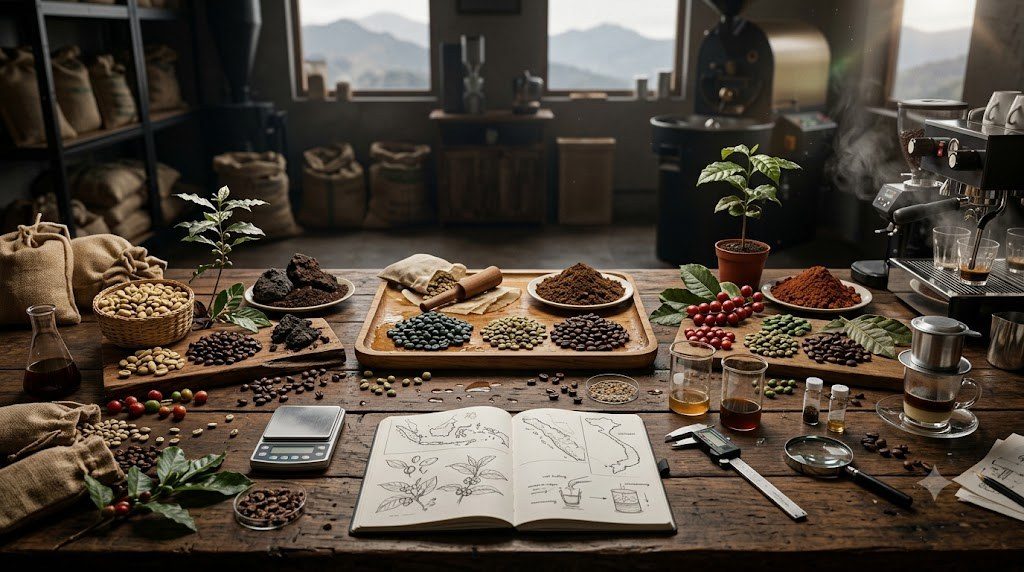
Maritime Equatorial Coffee Agronomy & Regional Processing
An in-depth investigation into the diverse coffee terroirs of the Asia-Pacific region. We examine the unique volcanic island geography of Indonesia, dissect the biochemistry of Sumatra’s wet-hulling (Giling Basah) processing method, analyze the high-yield Robusta agronomy of Vietnam’s Central Highlands, and explore specialty origins in Papua New Guinea and India.
The Asia-Pacific coffee region represents a captivating and ecologically diverse territory within the global Bean Belt. Stretching across thousands of equatorial islands from the Indian subcontinent through the Indonesian archipelago to Papua New Guinea, and across mainland Southeast Asia into the highland plateaus of Vietnam, this vast area encompasses radically divergent growing environments, agricultural traditions, and post-harvest processing methods.
While the Americas are famous for washed and honey-processed coffees and East Africa is revered for vibrant florals, the Asia-Pacific axis is celebrated for unique flavor profiles: deep earthy undertones, heavy syrupy bodies, complex forest aromas, and rich spice notes.
1. The Indonesian Volcanic Archipelago: Ring of Fire Pedology
Indonesia’s coffee-growing geography is defined by its position along the Pacific Ring of Fire, an active tectonic subduction zone where the Indo-Australian Plate plunges beneath the Eurasian Plate. Over millions of years, explosive volcanism created the islands of Sumatra, Java, Bali, Flores, and Sulawesi, depositing deep layers of weathered andesitic and basaltic volcanic ash.
These volcanic Andisols possess exceptional physical properties: loose, crumbly loam textures, high cation exchange capacity (CEC), and outstanding water-holding capacity that buffers coffee trees against tropical dry spells. However, the maritime equatorial climate presents persistent agronomic challenges: torrential daily rainfall and atmospheric relative humidity that frequently exceeds 85% to 95%.
2. The Biochemistry of Sumatran Wet-Hulling: Giling Basah
Nowhere in the world is post-harvest processing more intimately shaped by climate than in Sumatra (across growing regions including Aceh Gayo, Lake Toba, and Lintong). To cope with relentless tropical humidity, Sumatran farmers developed a unique processing technique known locally as Giling Basah (Wet-Hulling).
The mechanics and biochemical consequences of wet-hulling proceed through distinct phases:
- Pulping and Overnight Fermentation: Smallholders depulp freshly picked cherries with hand-cranked machines and ferment the seeds overnight in plastic bags or woven sacks to loosen mucilage.
- First Sun Drying (To 30%–40% Moisture): Farmers wash the mucilage off and spread the wet parchment onto patios for just 1 to 2 days, reducing moisture from roughly 50% down to
30%–40%(a stage known as gabah basah). At this point, the bean inside is swollen, pliable, and soft. - Mechanical Wet-Hulling: Instead of waiting weeks for the parchment to dry down to the standard 11% moisture before hulling, farmers take the semi-wet parchment directly to local collectors equipped with high-friction hulling machines. The machine shears the wet, soft cellulosic parchment shell away from the swollen green bean, exposing the naked endosperm.
- Second Drying (Naked Seed Desorption): The naked, unshielded green beans are laid directly back onto patios to finish drying down to
11%–12% moisture. During this second drying phase, ambient oxygen, direct sunlight, and airborne microflora interact directly with the cellular endosperm, triggering enzymatic oxidation and imparting the signature deep jade-green or bluish hue.
| Origin Region | Primary Species & Cultivars | Harvest Processing Method | Key Terroir Factors | Cup Flavor Characteristics |
|---|---|---|---|---|
| Sumatra (Aceh Gayo & Lintong) | Arabica (Ateng, Tim Tim, Typica) | Giling Basah (Wet-Hulling) | Volcanic soils around Lake Toba, 1,200–1,600 masl | Dark chocolate, cedar wood, pipe tobacco, earthy moss, grapefruit, heavy syrupy body |
| Sulawesi (Toraja & Enrekang) | Arabica (S795, Typica) | Giling Basah & Fully Washed | High-altitude mountain spine, 1,300–1,800 masl | Warming spices, cinnamon, sweet herbal, dark berries, clean citric finish |
| Java (East Java Estate Plateaus) | Arabica (Java, USDA selections) | Fully Washed (Government Estates) | Ijen volcanic caldera plateaus, 1,100–1,500 masl | Nutty, sweet malt, baker’s chocolate, cedar, low acidity, smooth clean body |
| Vietnam (Dak Lak & Lam Dong) | Robusta & Arabica (Catimor) | Dry Natural & Wet Washed | Red basaltic soils, intensive irrigation, 600–1,400 masl | Dark cocoa, roasted walnut, caramelized brown sugar, full thick mouthfeel |
| Papua New Guinea (Western Highlands) | Arabica (Blue Mountain, Arusha) | Fully Washed (Plantation & Smallholder) | Waghi Valley volcanic soils, 1,400–1,900 masl | Crisp red apple, sweet tropical fruit, stone fruit, cane sugar, tea-like body |
Sensory Attributes of Giling Basah: Earthy, Herbal, and Heavy Bodied
Because the protective parchment is removed while the bean is still damp, natural organic acids (citric and malic) oxidize and degrade during drying. This lowers perceived acidity and amplifies heavy, viscous mouthfeel.
In the cup, top-grade wet-hulled lots exhibit complex savory-sweet profiles: cedar wood, dark baker’s chocolate, pipe tobacco, forest moss, warming spices (nutmeg, clove), and a thick syrupy body that makes them prized components for dark-roasted espresso blends.
3. Vietnam’s Industrial Robusta Heartland: The Central Highlands
Vietnam represents the agricultural opposite of Indonesia’s artisanal smallholder systems. In the Central Highlands (Tây Nguyên) across provinces including Dak Lak, Lam Dong, Dak Nong, and Gia Lai, Vietnamese agriculture operates on high-density, high-yield Robusta cultivation.
Vietnamese producers achieve remarkable yields exceeding 3.0 to 4.5 metric tons of green coffee per hectare through intensive agronomic management: cloned elite selections, deep red basaltic soil nutrition, and systematic basin irrigation during the dry season. While historically targeted at commercial instant coffee manufacturers, progressive producers in the Da Lat highlands are developing high-grade Fine Robusta and specialty Arabica micro-lots that are reshaping international perceptions.
4. Island Terroirs: Sulawesi Toraja, Bali Kintamani, and Flores Bajawa
Beyond Sumatra and Java, Indonesia’s outer islands offer distinct specialty microclimates:
- Sulawesi (Toraja): Grown along the rugged, high-altitude spine of South Sulawesi (1,300 to 1,800 masl) by the Torajan people. Sulawesi coffees combine the body of wet-hulling with crisp citric acidity and warm spice notes of cardamom and clove.
- Bali (Kintamani): Grown on the volcanic slopes of Mount Batur under the traditional Subak Abian agricultural management system—an ancient community water and forest cooperative founded on Hindu philosophy. Bali lots are predominantly wet-washed, delivering sweet orange citrus, dark chocolate, and floral tea clarity.
- Flores (Bajawa): Cultivated on the slopes of the Inerie volcano. Deep volcanic andisols produce rich coffees with sweet milk chocolate, macadamia nut, and balanced caramel finishes.
6. The Monsoon Malabar Phenomena: Oceanic Weathering and Aging Physics
Along the Malabar Coast of southwestern India (in the states of Karnataka, Kerala, and Tamil Nadu), coffee producers practice one of the most unusual post-harvest processing methods in the global coffee trade: Monsooning.
The historical origins and physical science of Monsoon Malabar reflect maritime trade history:
- Historical Origin: During the era of the British East India Company, wooden sailing ships carried green coffee from India to Europe around the Cape of Good Hope, a voyage lasting four to six months. In transit, high oceanic humidity and salty sea winds caused green beans to absorb ambient moisture, swell in physical volume, lose their bright blue-green tint to a pale golden yellow, and shed their natural acidity, yielding a remarkably mellow, earthy cup.
- The Controlled Monsooning Process Today: When modern steamships shortened the voyage to a few weeks, European consumers complained that Indian coffee had lost its unique flavor! In response, Indian processors created coastal curing sheds to replicate the oceanic journey. Top-grade cherry-dried Arabica (Grade A) is laid out in open-sided coastal warehouses during the southwest monsoon season (June through September).
- Physical and Sensory Transformation: Over 12 to 16 weeks, moist, humid sea winds sweep through the curing sheds. Workers rake the beans continuously to ensure even exposure. The seeds absorb moisture until bean moisture reaches
14.5% to 15.0%, expanding to almost double their original physical size and turning pale straw-gold. The beans are then dry-milled and polished. In the cup, Monsooned coffee has virtually zero citric or malic acidity, offering heavy, syrupy body, spice notes of cardamom, clove, malt, and pipe tobacco—prized by European roasters as a base for low-acid espresso blends.
7. Vietnam’s Robusta Agronomy and the Dak Lak Irrigation Revolution
Over the past four decades, Vietnam has transformed into an agricultural powerhouse, rising to become the world’s second-largest coffee producer and the undisputed leader in Robusta cultivation. Concentrated in the Central Highlands (Tây Nguyên) across provinces including Dak Lak, Lam Dong, Dak Nong, and Gia Lai, Vietnamese coffee production represents an intense, high-yield agricultural ecosystem.
Key dynamics of Vietnamese coffee production include:
- Basalt Red Soils and High-Density Planting: The fertile, weathered red basaltic soils of the Buon Ma Thuot plateau provide abundant mineral nutrition. Farmers plant cloned Robusta varieties (such as TR4 and TR9 selections) at high densities of
1,000 to 1,300 trees per hectare. - Intensive Basin Irrigation: The Central Highlands experience a pronounced dry season from December through April, which coincides with floral bud induction and cherry development. Vietnamese farmers dig large earthen basins around individual tree bases, pumping groundwater from local aquifers directly to tree root zones (typically 400 to 600 liters of water per tree per round across three to four irrigation cycles).
- The Shift Toward Specialty Fine Robusta in Lam Dong: In the cooler, higher-elevation districts of Lam Dong around Da Lat (elevation 1,200 to 1,500 masl), progressive growers are planting high-altitude Arabica (Catimor and Bourbon) alongside selectively picked Fine Robusta. By implementing parabolic drying beds and controlled anaerobic fermentations, Vietnamese specialty producers are winning international awards with lots exhibiting dark cocoa, dried fig, and hazelnut praline notes.
8. The Smallholder Landscape of Papua New Guinea’s Waghi Valley
In the rugged Eastern and Western Highlands of Papua New Guinea (PNG), coffee farming represents an extraordinary convergence of Caribbean genetics and South Pacific volcanic geography. In the late 1920s, British colonial agricultural officers imported true Jamaican Blue Mountain seeds to the government experimental station at Sangara, establishing the genetic foundation of PNG Arabica.
Today, roughly 85% of PNG’s coffee is cultivated by indigenous smallholder farmers in remote tribal village ‘gardens’ throughout the Waghi and Goroka valleys at altitudes between 1,400 and 1,900 masl. Soils are deep, fertile volcanic loams nourished by regular equatorial rain. Because road infrastructure across the highlands remains minimal, smallholders hand-depulp cherries on small wooden machines, wash the parchment in wooden troughs or mountain streams, and transport bags on foot or via light aircraft to central dry mills. In the cup, high-grade PNG washed lots exhibit sweet stone fruit, brown sugar, crisp green apple, and a delicate, black-tea clarity that stands in striking contrast to Sumatra’s heavy wet-hulled profiles.
Asia-Pacific Regional Quality Identifiers
1. Sumatra (Lintong, Mandheling, Gayo): Wet-hulled lots exhibit dark jade green seeds, intense herbal, cedar, dark cocoa, and sweet tobacco notes with heavy body.
2. Sulawesi (Toraja): High-altitude mountainous volcanic terroir yielding clean citric acidity, sweet grapefruit, warming spices, and creamy mouthfeel.
3. Papua New Guinea (Wahgi Valley): Blue Mountain cultivars imported from Jamaica in the 1920s, washed and dried in the Eastern Highlands, delivering crisp stone fruit, sweet apple, and black tea body.
10. Toraja and Kintamani: Indigenous Cooperative Management and Heritage Cultivars
Beyond Sumatra’s commercial trade, the island microclimates of Sulawesi and Bali highlight how indigenous cultural systems safeguard specialty quality and genetic preservation across the Indonesian archipelago.
The Tana Toraja Highland Ecosystem:
In the mist-covered mountains of South Sulawesi, the Torajan people have cultivated Arabica since the mid-19th century. Grown in rugged volcanic valleys at elevations between 1,400 and 1,850 masl, Torajan coffee is dominated by heritage selections of S795 (an early Indian hybrid of Typica and Coffea liberica renowned for natural rust resistance) and ancient Typica variants. The combination of high altitude, rich volcanic Andisols, and careful selective picking produces a cup that marries the syrupy body of Indonesian coffee with bright, sweet grapefruit acidity, cinnamon bark, and floral cardamon aromatics.
The Balinese Subak Abian Cooperative Philosophy:
On the volcanic slopes surrounding Mount Batur in the Kintamani highlands of central Bali, coffee farming is governed by the ancient Subak Abian system—an agrarian and philosophical framework founded on the Hindu principle of Tri Hita Karana (harmony between humans, nature, and the divine). Under Subak Abian rules, the use of synthetic chemical fertilizers and pesticides is strictly prohibited. Coffee trees are shaded by mandarin orange and shade-giving Albizia trees, fertilized solely with organic compost and cattle manure. In the cup, Kintamani coffees—processed via modern wet-washing—deliver clean citric orange blossom, sweet cocoa, and delicate brown sugar notes.
The intercropping with citrus trees produces a noticeable agroecological benefit: the fragrant blossom pollen attracts diverse native pollinator populations, enhancing fruit set synchrony. Furthermore, the light shade cast by citrus canopies reduces ground evaporation, allowing topsoil moisture to remain steady throughout the dry season and ensuring uniform bean development across the plateau.