Quality Metrology, SCAA Defect Standards & Physical Evaluation
A rigorous, professional masterclass in green coffee evaluation, physical defect sorting, moisture metrology, water activity (aw) thresholds, screen size fractionation, and the Specialty Coffee Association (SCA) 350-gram protocol. We examine the biological origins of primary vs. secondary defects and how each physical flaw manifests in roasting and cup scoring.
Before any lot of green coffee is contracted, roasted, or poured into a cup, it must clear the rigorous threshold of Physical Green Grading. While sensory cupping evaluates subjective flavor attributes, green grading is an empirical, quantitative science that measures physical integrity, uniform density, water content, and the statistical presence of agricultural defects.
A single defective bean can ruin an entire 200-gram retail bag of coffee. Recognizing this reality, the Specialty Coffee Association (SCA, historically SCAA) and the Coffee Quality Institute (CQI) developed standardized, international grading protocols. In this guide, we break down the standards, physical testing equipment, defect taxonomy, and sensory consequences of green coffee grading.
1. The SCA 350-Gram Physical Inspection Standard
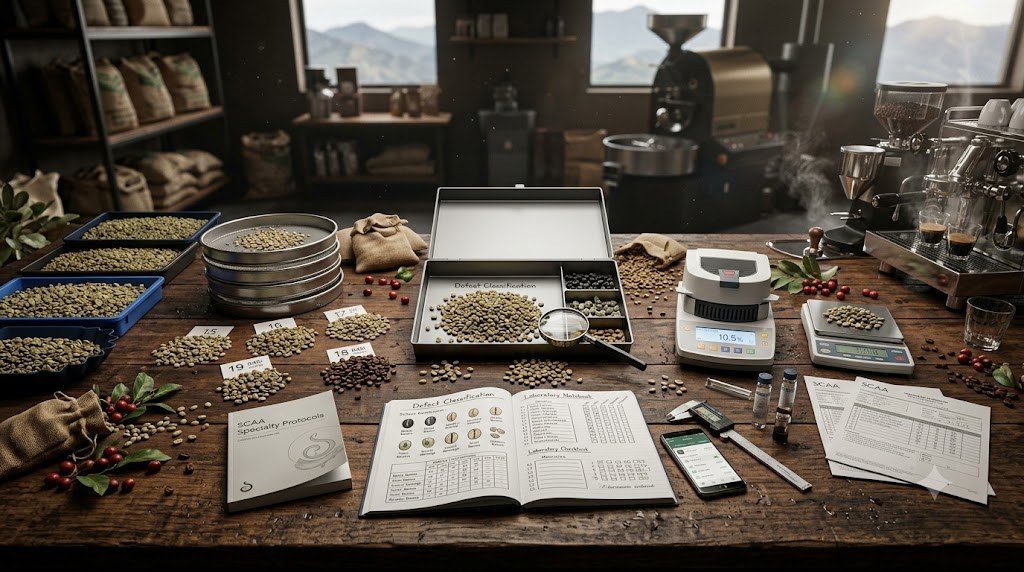
Under official SCA protocols, green coffee grading is conducted using a representative 350-gram sample extracted from a 60-kilogram or 69-kilogram jute burlap bag via an approved trier probe. The inspection must be carried out on a clean, neutral-colored grading mat under standardized lighting providing a minimum of 1,000 lux (100 foot-candles) of illumination at surface level.
To qualify as official Specialty Grade (Grade 1), the sample must satisfy strict criteria:
- Zero Primary (Category 1) Defects: The 350-gram sample must possess zero full primary defects.
- Maximum of 5 Secondary (Category 2) Defects: No more than 5 full secondary equivalent defects are permitted.
- Moisture Content Specifications: Measured internal moisture must sit strictly between
10.0% and 12.0%for washed coffees (or 10.0%–13.0% for naturals) at origin export. - Water Activity (aw) Range: Safe water activity must fall between
0.55 and 0.65 awto inhibit microbial growth and enzymatic lipid hydrolysis. - Sensory Cupping Score: When roasted to light-medium color (Agtron 58–63) and cupped, the sample must achieve a minimum score of 80.00 points on the 100-point SCA cupping form with zero cup taints or defects.
2. Category 1: Primary Defects and Their Biological Origins
Primary defects represent severe biological, fungal, or harvesting failures. The presence of even a single primary defect in a 350-gram sample immediately disqualifies the entire container load from receiving Specialty Grade certification:
| Defect Name | Category | Count for 1 Full Defect | Agronomic / Processing Cause | Sensory Impact in Cup |
|---|---|---|---|---|
| Full Black | Category 1 (Primary) | 1 bean | Extreme over-fermentation, water starvation, or frost damage | Pungent ash, burnt rubber, harsh medicinal, moldy bitterness |
| Full Sour | Category 1 (Primary) | 1 bean | Bacterial over-fermentation in tanks; acetic acid accumulation | Pungent vinegar, spoiled rotting fruit, sharp sour taint |
| Pod / Dried Cherry | Category 1 (Primary) | 1 cherry | Incomplete hulling; dry pulp husks remaining around seed | Heavy ferment, mold, dirt, harsh astringent woody taste |
| Fungus Damaged | Category 1 (Primary) | 1 bean | Aspergillus / Penicillium growth during humid drying or storage | Musty, dirty basement, damp cellar, medicinal, toxic mold |
| Severe Insect Damage | Category 1 (Primary) | 5 beans | Coffee Berry Borer (Hypothenemus hampei) perforations (3+ holes) | Dirty, cardboard, rancid, potato-like off-flavor |
| Foreign Matter | Category 1 (Primary) | 1 item | Stones, sticks, metal, animal debris accidentally packed | Severe mechanical grinder damage; safety contamination |
| Parchment Bean | Category 2 (Secondary) | 5 beans | Improper hulling leaves dry cellulosic shell intact | Woody, grassy, papery dryness, uneven roast development |
| Floater / Bleached | Category 2 (Secondary) | 5 beans | Improper drying; low density caused by pest or nutritional lack | Straw, hay, flat, hollow, cardboard, zero acidity |
| Immature / Quaker | Category 2 (Secondary) | 5 beans | Cherries picked under-ripe; low sucrose and chlorogenic accumulation | Peanut skin, grassy, cereal, popcorn, astringent bitterness |
| Broken / Cut / Chipped | Category 2 (Secondary) | 5 beans | Mechanical damage during pulping or hulling machinery friction | Blistered edges during roast, baked flavor, uneven extraction |
The Chemistry of the Quaker Bean
An immature bean—often visible only after roasting as a pale, blonde ‘quaker’—fails to brown during the roast. Because the coffee cherry was picked before physiological ripening, the endosperm lacked the required concentrations of sucrose and amino acids needed to fuel the Maillard reaction and caramelization.
When ground into a batch, quakers introduce unpleasant dry peanut-skin, wheat, and cardboard astringency. Graders detect quakers visually after roasting: Specialty Grade allows a maximum of 3 quakers per 100 grams of roasted coffee.
3. Screen Size Grading and Density Separation Mechanics
Coffee grading systems also classify beans by physical dimensions. Green coffee is mechanically passed over stacked vibrating perforated metal screens. Screen sizes are calibrated in increments of 1/64th of an inch:
- Screen 18 (18/64 in ≈ 7.14 mm): Designated as ‘Supremo’ in Colombia, ‘AA’ in Kenya, and ‘Strictly Hard Bean (SHB) Large’ in Central America.
- Screen 16–17 (16/64 to 17/64 in ≈ 6.35–6.75 mm): Designated as ‘Excelso’ in Colombia and ‘AB’ in Kenya.
- Screen 15 and below: Common commercial grades or peaberry fractions.
- The Peaberry (Caracolillo) Phenomenon: In roughly 5% of coffee cherries, only a single ovule is fertilized instead of two. The single seed develops into a round, pea-shaped seed rather than two flat-sided beans. Peaberries are separated via slotted screens and celebrated for their dense cellular structure and uniform heat transfer during roasting.
While larger beans were historically equated with higher quality, modern specialty coffee science demonstrates that density—not sheer size—is the true correlate of cup complexity. High-altitude coffees ripen slowly, generating dense, compact cellular matrices that roast with exceptional thermal stability.
4. Moisture Content and Water Activity (aw) Dynamics
Modern green coffee analysis has evolved beyond simple moisture meters into the domain of Water Activity (aw) metrology. While total moisture measures the overall percentage of water mass within the bean (recommended at 10.0%–11.5%), water activity measures the energy state of that water—the unbound, free water molecules available to fuel microbial proliferation and chemical reactions.
- Critical Threshold (0.60 aw): Above 0.60 aw, filamentous xerophilic molds (Aspergillus and Penicillium) can germinate and produce mycotoxins, even if total moisture appears within normal limits.
- Lipid Peroxidation & Fading: High water activity drives rapid enzymatic degradation of lipids, causing green coffee to lose its rich blue-green color, fade to yellow, and develop past-crop ‘baggy’ or cardboard flavors within months of export.
- Hermetic Storage Solutions: To preserve green coffee quality across oceanic transit, specialty producers utilize multi-layer hermetic barrier liners (such as GrainPro or Ecotact) inside traditional jute bags. These gas-impermeable barriers maintain equilibrium relative humidity, prevent ambient moisture re-absorption, and extend green shelf life from 6 months to over 24 months.
5. Secondary Defects: Minor Agricultural Flaws and Their Cumulative Toll
While primary defects represent catastrophic flaws that immediately disqualify a coffee from specialty status, Secondary (Category 2) Defects represent minor agricultural, mechanical, or processing flaws. While a single secondary defect may not ruin an entire batch, their cumulative presence degrades cup sweetness, introduces astringency, and leads to uneven roasting development.
Under SCA protocols, secondary defects are evaluated on a fractional point basis where a specific count of imperfect beans equals one full defect:
- Partial Black (3 beans = 1 full defect): Beans displaying localized black discoloration covering less than half the surface. Caused by partial fungal attack, nutritional deficiency, or light frost. Contributes muted ashiness and harsh phenolic notes.
- Partial Sour (3 beans = 1 full defect): Beans displaying yellowish-reddish or light brownish stains with localized bacterial fermentation. Contributes mild sour astringency, cider vinegar notes, or grassy off-tastes.
- Slight Insect Damage (10 beans = 1 full defect): Beans displaying one or two tiny puncture holes from the Coffee Berry Borer (Hypothenemus hampei). Allows ambient fungi to penetrate into the seed during drying, muting delicate enzymatic aromatics.
- Chipped, Cut, or Broken Beans (5 beans = 1 full defect): Caused by misaligned depulper knives, friction hullers, or aggressive mechanical sorting. Because the damaged edges expose cellular endosperm directly to heat during roasting, these broken fragments char and burn early in the roast cycle, imparting baked, acrid notes to the cup.
- Withered Beans (5 beans = 1 full defect): Wrinkled, undersized beans caused by drought stress or poor nutritional translocation during fruit development. These beans have low cellular density, roasting erratically and tasting papery, hollow, and dry.
6. The SCAA Cupping Protocol and 100-Point Sensory Evaluation
Once physical green grading is complete, the coffee must undergo formal sensory evaluation via the internationally standardized SCA Cupping Protocol. Cupping provides an objective, reproducible methodology for evaluating flavor attributes, free from the variables of individual brewing equipment.
The standard cupping protocol follows strict laboratory guidelines:
- Sample Roasting and Preparation: Samples are roasted within 24 hours of cupping to a light roast profile (Agtron Commercial 58, Gourmet 63 ±1). Beans are rested for 8 to 24 hours before grinding.
- Dosing and Grind Size:
8.25 grams of whole bean coffeeper150 mL of water(a brew ratio of 5.5% or 0.055 g/mL). The coffee is ground coarse (70%–75% passing through a U.S. Standard 20 mesh sieve). Five cups are prepared per sample to assess uniformity. - Water Quality and Infusion: Clean, odor-free water heated to
93°C (200°F)with Total Dissolved Solids between 75 and 150 mg/L is poured directly onto the dry grounds. The slurry steeps undisturbed for exactly 4 minutes. - Breaking the Crust: At the 4-minute mark, the cupper breaks the crust by gently pushing a cupping spoon through the floating grounds three times, inhaling the burst of released volatile aromatics (Aroma evaluation). Grounds are then skimmed from the surface.
- Slurping and Sensory Scoring: Once the liquid cools to roughly
70°C (160°F), the cupper aspirates a spoonful of liquid forcefully into the palate, atomizing the coffee across the tongue and retro-nasal olfactory receptors. Attributes scored on the 10-point scale include: Fragrance/Aroma, Flavor, Aftertaste, Acidity, Body, Balance, Uniformity, Clean Cup, Sweetness, and Overall.
7. SCAA Cupping Score Classification Matrix
The cumulative sum of the 10 cupping categories yields the final numerical score, establishing the commercial grade and market valuation of the lot:
| Cupping Score Range | Classification Tier | Green Defect Criteria | Commercial & Sensory Description |
|---|---|---|---|
| 90.00 – 100.00 points | Super Specialty (Presidential Award) | 0 Primary defects, ≤ 3 Secondary defects | Exquisite, transcendent complexity, dazzling floral aromatics, flawless clarity |
| 85.00 – 89.99 points | Specialty Grade (Origin Exemplar) | 0 Primary defects, ≤ 5 Secondary defects | Distinct origin character, vibrant acidity, complex sweetness, heavy clean body |
| 80.00 – 84.99 points | Specialty Grade (Standard) | 0 Primary defects, ≤ 5 Secondary defects | Clean cup, solid sweetness, balanced acidity, zero taints or defects |
| 75.00 – 79.99 points | Premium / High Commercial | 6 to 10 full defects permitted | Acceptable everyday cup, mild sweetness, slightly muted origin character |
| 70.00 – 74.99 points | Commercial / Commodity | 11 to 20 full defects permitted | Basic industrial coffee, flat, woody, bitter, heavy roast required |
| Below 70.00 points | Off-Grade / Industrial Utility | Extensive primary defects present | Unpleasant off-tastes, sour, moldy, medicinal, destined for instant coffee fillers |
8. The Economics of Green Quality: Specialty Differentials and Traceability
The distinction between commodity commercial coffee and specialty grade is not merely an academic exercise; it dictates the financial viability of farming communities across the global coffee belt. Commercial coffee is traded on the New York Intercontinental Exchange (the ‘C-Market’) as an undifferentiated commodity, where prices fluctuate based on currency hedge funds, Brazilian weather forecasts, and speculative macroeconomic cycles, frequently dropping below the basic cost of agricultural production.
In contrast, coffees certified as Specialty Grade (scoring 80.00+ points with verified zero primary defects) decouple from the C-Market, trading at substantial quality premiums based on cup excellence, single-estate traceability, and varietal pedigree. Elite micro-lots scoring 88 to 92 points frequently command direct-trade farmgate prices ranging from $10.00 to over $100.00 per pound at prestigious international auctions like the Cup of Excellence and Best of Panama.
Traceability documentation accompanying export lots now details precise geographic coordinates (GPS), estate elevation bands, harvest dates, lot numbers, specific fermentation tank IDs, and Q-Grader calibration certificates. By treating green coffee as an artisanal agronomic product rather than an anonymous bulk commodity, the specialty grading protocol ensures economic sustainability and rewards agricultural excellence.
Moreover, recent innovations in digital green metrology have introduced near-infrared (NIR) spectrometry and computerized image analysis into commercial dry mills. Handheld NIR scanners allow green buyers to evaluate internal lipid concentrations, moisture uniformity, and organic acid distributions across thousands of beans in seconds, eliminating human bias from physical grading tables and establishing a seamless digital chain of custody from African washing stations and Latin American fincas directly to consumer roasteries.
This data-driven approach allows specialty roasters to predict roast behavior before green lots ever enter the roasting drum. Knowing the exact water activity and cellular density distribution helps roastmasters tailor heat application, charge temperatures, and airflow curves with mathematical precision, preventing tipping, scorching, and underdeveloped cores across varying bean screen sizes and crop origins.
Green Quality Assurance: The Triple-Barrier Protection Method
1. Strict Sampling Protocol: Use a multi-tier probe to sample at least 10% of bags in a container lot, blending thoroughly to ensure a statistically representative composite.
2. Optical Sorting Technology: Modern processing mills deploy trichromatic digital cameras and infrared laser sorters that scan 10,000 beans per second, ejecting defective discolored beans with high-pressure air bursts.
3. Vacuum Packing & Low-Oxygen Freight: Elite specialty micro-lots (scoring 88+) are vacuum-sealed in 15kg or 30kg foil-laminated bags to eliminate oxygen and maintain green stability across trans-oceanic shipping.