Sensory Metrology, Laboratory Standards & Scientific Evaluation
A rigorous, professional masterclass in green coffee evaluation, sample roasting protocols, SCAA cupping laboratory calibration, near-infrared Agtron color grading, and sensory taxonomy via the World Coffee Research (WCR) Sensory Lexicon.
In the global specialty coffee trade, millions of dollars in green coffee contracts are transacted based on a standardized 100-point sensory evaluation: the SCA Cupping Protocol. Because green coffee cannot be consumed in its raw agricultural state, it must be roasted, ground, infused with hot water, and evaluated under laboratory conditions designed to eliminate machine bias and highlight inherent agricultural quality.
Sample roasting is not intended to produce a delicious, shelf-ready retail product. Rather, its objective is to prepare a standardized, lightly developed sample that reveals both the virtues (sweetness, acidity, florals) and flaws (unripe quakers, over-ferment, mold, phenolic taints) of the green lot. In this guide, we break down sample roasting specifications, sensory laboratory physics, and calibration protocols.
1. Sample Roasting Specifications: The SCAA Benchmark
Under official Specialty Coffee Association protocols, sample roasting must adhere to strict parameters to ensure global reproducibility:
- Batch Size: Typically
100 grams ± 10 gramsof green coffee per barrel or chamber. - Roast Duration Window: Total roast time must fall strictly between 8 and 12 minutes. Fast flash roasts (under 6 minutes) or prolonged baked roasts (over 13 minutes) distort organic acid and sugar development.
- First Crack & Discharge: The sample is dropped shortly after First Crack concludes. The roast must show zero scorching, tipping, or facing on the bean surface.
- Target Roast Color: Light-medium roast color verified via near-infrared spectrophotometer:
- Agtron Commercial Scale:
58 ± 1on whole bean;63 ± 1on ground coffee. - Agtron Gourmet Scale:
63 ± 1on whole bean;73 ± 1on ground coffee.
- Agtron Commercial Scale:
- Immediate Quenching and Resting: Samples must be immediately air-cooled to room temperature within 3 minutes and rested in airtight containers for a minimum of
8 hours up to 24 hoursbefore cupping.
2. Sensory Cupping Laboratory Specifications
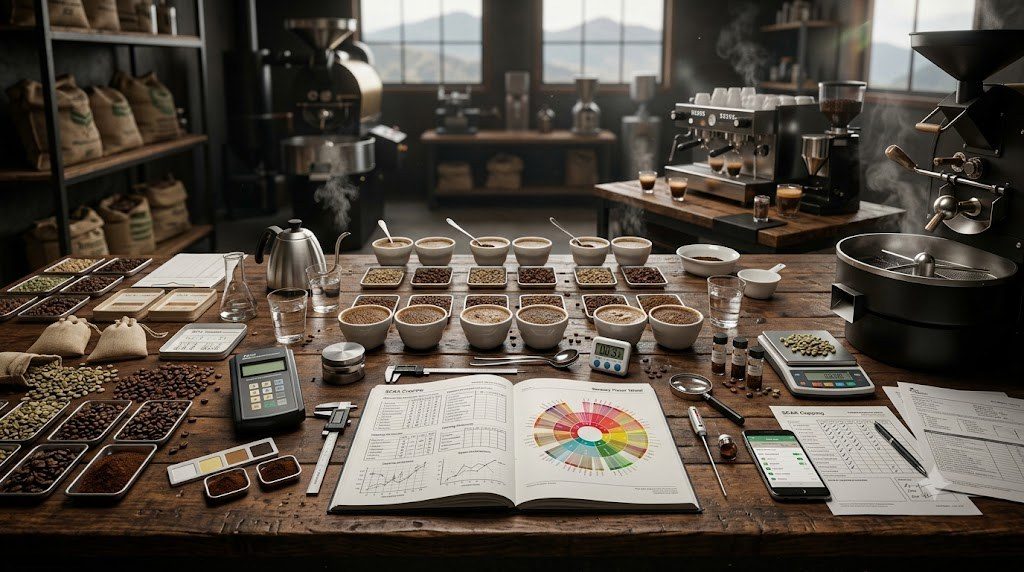
To eliminate sensory distractions and environmental variables, the cupping laboratory must comply with strict physical standards:
| Environmental Variable | SCAA Laboratory Standard | Tolerable Deviation | Sensory Impact If Violated |
|---|---|---|---|
| Ambient Room Temp | 20°C – 22°C (68°F – 72°F) | ± 1.5°C | Cold air cools cups prematurely; hot air dulls olfactory sensitivity |
| Relative Humidity | 45% – 55% RH | ± 5% | High humidity alters ground sample moisture absorption |
| Surface Illumination | 1,000 – 1,200 lux (daylight) | Color balanced (5,000K) | Poor light distorts visual green grading and quaker detection |
| Cupping Glass Volume | 207 mL – 266 mL (7 – 9 oz) | Tempered glass / porcelain | Alters thermal mass and cooling rate during sensory slurping |
| Water TDS Balance | 75 – 150 mg/L (ppm) | Target 125 ppm | Low TDS under-extracts; high TDS buffers and mutes acidity |
| Brew Water Temp | 93.0°C ± 0.5°C (200°F) | Infused immediately | Boiling water extracts bitter tannins; cooler water under-extracts |
3. The Mathematical Cupping Ratio and Grind Size Calibration
The SCA cupping protocol prescribes an exact brewing ratio based on dry ground mass to water volume:
Standard Dose: 8.25 grams of whole bean coffee per 150 mL of water (0.055 g/mL)
- Grind Size Specification: Coffee is ground slightly coarser than standard drip filter paper grind, calibrated so that
70% to 75% of grounds pass through a U.S. Standard 20 mesh sieve (850 microns). - Five-Cup Sample Uniformity: Exactly five individual cups must be prepared per lot. Grinding five cups separately ensures that if a single defective bean (such as a ferment or quaker) is present in the sample, it will contaminate only one cup, allowing the cupper to score ‘Uniformity’ and ‘Clean Cup’ objectively.
4. The Sensory Cupping Timeline: Breaking the Crust to Cold Slurp
The sensory evaluation progresses through four distinct thermal milestones:
- Fragrance (Dry Grounds, Minute 0): Cuppers evaluate dry grounds within 15 minutes of grinding, noting volatile enzymatic aromatics.
- Aroma (Crust Infusion, Minutes 0 to 4): Hot water is poured onto grounds. Grounds float to the surface, forming a dense aromatic crust.
- Breaking the Crust (Minute 4): At exactly 4:00, the cupper positions their nose directly above the cup and gently breaks the crust with a cupping spoon three times, inhaling the trapped burst of volatile aromatics. Floating foam and grounds are skimmed and discarded.
- Slurping and Scoring (Minutes 8 to 25, 70°C down to 25°C): Slurping aspirates the liquid forcefully across the tongue and into the retro-nasal cavity. The sample is scored as it cools across three temperature stages: Hot (Flavor, Aftertaste), Warm (Acidity, Body, Balance), and Cold (Sweetness, Uniformity, Cleanliness).
6. Laboratory Sample Roaster Mechanics: Ikawa, Probat, and Diedrich
To evaluate green coffee contracts objectively, green buyers and quality laboratories utilize specialized miniature roasters known as Sample Roasters. Unlike production machines designed to roast 15 to 120 kilograms per batch, sample roasters process tiny batches of 50 to 150 grams, providing rapid, highly reproducible assessments of green coffee quality without masking defects behind heavy roast development.
The primary engineering categories of modern sample roasters include:
- Fluid-Bed Micro-Roasters (Ikawa Digital Standard): Utilizing precision electric heating coils and high-velocity vertical airflow, fluid-bed roasters suspend a 50-gram dose of green coffee on a cushion of hot air. Digital PID controllers execute programmable temperature and airflow curves via micro-sensors, delivering repeatable roast curves across multiple origins with push-button precision.
- Miniature Drum Roasters (Probat Sample Roaster / Diedrich IR-1): Traditional solid-drum sample roasters utilize gas burners or ceramic infrared heaters. They simulate the exact heat transfer physics (conductive-convective ratio) of full-scale production roasters, allowing roastmasters to evaluate how lots respond to conductive drum contact before scaling up production.
7. Sensory Flavor Wheels: The WCR Sensory Lexicon and SCAA Matrix
In 2016, World Coffee Research (WCR) and the Specialty Coffee Association unveiled the updated Coffee Taster’s Flavor Wheel, representing the largest collaborative sensory science initiative in coffee history. Developed at Kansas State University’s Sensory Analysis Center, the flavor wheel transformed subjective cupping descriptions into an empirical scientific taxonomy.
The structure and application of the WCR Sensory Lexicon include:
- Universal Chemical Reference Standards: Every sensory descriptor on the wheel is anchored to a specific, reproducible chemical or grocery reference standard. For instance:
- Blueberry: Calibrated using 1.0 gram of crushed Oregon canned blueberries in 100 mL of water.
- Jasmine: Anchored to pure Jasminum officinale floral water dilutions.
- Acetic Acid: Calibrated against 0.05% food-grade acetic acid solutions.
- Dark Chocolate: Referenced against 70% cocoa mass chocolate disks.
- Hierarchical Organization: Descriptors radiate outward from nine broad fundamental categories in the center (Floral, Fruity, Sour/Fermented, Green/Vegetative, Roasted, Spices, Nutty/Cocoa, Sweet, Other) to precise, outer-tier descriptors (e.g., Fruity → Berry → Blackberry), allowing cuppers to calibrate terminology across international boundaries.
8. Q-Grader Sensory Calibration and Calibration Bias Control
Professional green coffee evaluation is administered by certified Q-Graders, licensed by the Coffee Quality Institute (CQI) after completing a rigorous 6-day, 22-part sensory examination that evaluates sensory acuity, triangulation discrimination, organic acid identification, and standardized scoring precision.
To eliminate personal bias, cupping panels follow strict protocols:
- Double-Blind Triangulation: Samples are coded with randomized alphanumeric identifiers. In triangulation tests, graders evaluate sets of three cups (two identical, one different), identifying the odd cup out through smell and taste alone to assess sensory discrimination limits.
- Panel Averaging and Outlier Elimination: Production quality scores are derived from panels of 3 to 5 calibrated Q-Graders. Individual scores are averaged across all panelists, and any score deviating by more than 1.5 standard deviations from the group mean is flagged for re-cupping, ensuring commercial integrity for international trade contracts.
Cupping Lab Best Practices: Environment and Water Quality
1. Lighting & Ambient Atmosphere: Maintain lab temperature at 20°C–22°C, humidity at 45%–55%, and color-balanced lighting (5,000K daylight spectrum, 1,000+ lux).
2. Water Mineral Balance: Cupping water must strictly adhere to SCA water standards: Total Dissolved Solids between 75 and 150 mg/L, total hardness 50–100 mg/L CaCO3, alkalinity 40 mg/L, and pH between 6.5 and 7.5.
3. Spoon Sanitization: Rinse cupping spoons in fresh hot water between every sip to prevent cross-contamination across cupping flights.
9. Retronasal Olfaction vs. Gustatory Tongue Receptors
During specialty cupping, human sensory physiology operates on two distinct biological systems that combine in the orbitofrontal cortex to create the perception of Flavor: Gustation (Taste) and Retronasal Olfaction (Smell).
The physiological mechanisms involved during the cupping slurp include:
- The Physics of the Cupping Slurp: When a cupper aspirates coffee forcefully from a cupping spoon, the rapid intake of air atomizes the liquid into a fine mist of micro-droplets. This atomization serves two critical functions: it coats the entire lingual surface of the tongue simultaneously and instantly aerosolizes volatile organic compounds (VOCs).
- Retronasal Olfactory Pathway: As the coffee mist passes the pharynx, volatile aroma molecules travel upward through the nasopharynx to the olfactory epithelium, binding to hundreds of millions of olfactory sensory neurons. This retronasal pathway accounts for over
80% to 90% of perceived flavor complexity(identifying specific fruit esters, floral monoterpenes, and roasted pyrazines). - Gustatory Lingual Receptors: True taste is restricted to the basic modalities detected by taste buds on the tongue: Sweetness (stimulated by soluble carbohydrates binding to T1R2/T1R3 receptors), Acidity/Sourness (hydrogen ion H+ influx through OTOP1 ion channels), Bitterness (TAS2R receptors detecting caffeine, quinic acid, and phenols), and Umami (glutamate and amino acid receptors).
10. Statistical Triangulation Testing and Sensory Bias Mitigation
In high-stakes green coffee procurement and quality assurance audits, international trading houses utilize Sensory Triangulation Testing (ISO 4120 standard) to verify lot uniformity and detect subtle batch deviations.
- Methodology: Panelists are presented with a triad of three coded cupping bowls: two bowls contain coffee from the control lot, while the third bowl contains coffee from the test lot. All three cups are ground and brewed under identical conditions, with visual cues eliminated using red monochromatic lighting.
- Statistical Significance: By chance alone, the probability of selecting the odd cup is exactly
p = 1/3 (33.3%). Using binomial distribution tables, if a panel of 12 calibrated Q-Graders produces 8 or more correct identifications (p < 0.05), the difference between the two lots is statistically significant, signaling either a subtle blend alteration, processing defect, or age-related fading that warrants commercial contract adjustments.
11. Organic Acid Cupping Flight Standards and Calibration Recipes
To train sensory panelists to identify individual organic acid pathways without coffee flavor interference, professional sensory academies prepare dedicated Spiked Acid Solutions using food-grade chemicals diluted in pure deionized water:
- Citric Acid Standard (0.40 g/L): Stimulates lateral tongue receptors, producing sharp, bright, mouth-watering salivary response reminiscent of lemon juice.
- Malic Acid Standard (0.35 g/L): Stimulates the palate with clean, refreshing, lingering crispness characteristic of unripe Granny Smith apples.
- Phosphoric Acid Standard (0.25 g/L): Produces an inorganic, non-astringent tingling sensation across the mucous membranes, increasing salivary fluidity without sour fruit flavor.
- Acetic Acid Standard (0.30 g/L): Imparts pungent volatile vapor aromatics and warming, winey cider vinegar notes.
- Quinic Acid Standard (0.40 g/L): Delivers lingering astringency and chalky bitterness at the back of the throat, teaching cuppers to differentiate dark roast pyrolytic breakdown from origin fruit acidity.
12. Modern Digital Cupping Forms: Tastify, Cropster, and Blockchain Auditing
While traditional cupping was recorded on physical paper forms with pencils, contemporary specialty operations rely entirely on cloud-synchronized digital sensory platforms (such as Tastify, Cropster Cup, and Catador). Cuppers enter scores on touchscreen tablets calibrated to the official SCA 100-point rubric.
The system automatically calculates radar spider charts, generates instant flavor cloud visualizations, and flags statistical scoring variance among panelists in real time. These digital sensory fingerprints are linked directly to export lots via decentralized blockchain ledgers, providing green coffee buyers and roasters with verifiable provenance and quality certification from origin washing stations directly to consumer packaging.
13. The Evolution of the SCA Coffee Value Assessment (CVA)
In 2023, the Specialty Coffee Association introduced the Coffee Value Assessment (CVA) system, modernizing the 2004 cupping form to separate objective descriptive sensory analysis from subjective affective (hedonic) preference scoring.
Under the CVA framework, cuppers evaluate lots across four distinct modules: Physical Assessment (moisture, defects, color), Descriptive Assessment (objective intensity of aromas and flavors using the WCR Lexicon), Affective Assessment (the cupper’s personal score of quality), and Extrinsic Assessment (identity, certifications, and terroir story). This evolution ensures that specialty coffees are valued not merely on arbitrary numerical scores, but on comprehensive descriptive data that aligns roaster expectations with agricultural realities.